Separate package | 1.0.0 published; 2.2.0 release candidate documented for DGS 4.0
AI Providers for Unity documentation.
Product-specific documentation for the reusable provider connectivity layer behind Beka Forge AI-enabled tools.
It covers provider assets, request transport, local key handling, runtime/editor request paths, and the public API core.
This guide describes the AI Providers 2.2.0 release candidate: saved profiles, six HTTP/API provider families plus editor-only subscription transports, protected local credentials, streaming, model discovery, and cancellable requests. The current Store listing remains 1.0.0; the matching DGS 4.0 integration requires the separate 2.2.0 update, which is not yet published.
6HTTP/API provider families
2Transport choices: API or editor subscription
0Dependencies on DGS or AI Extension
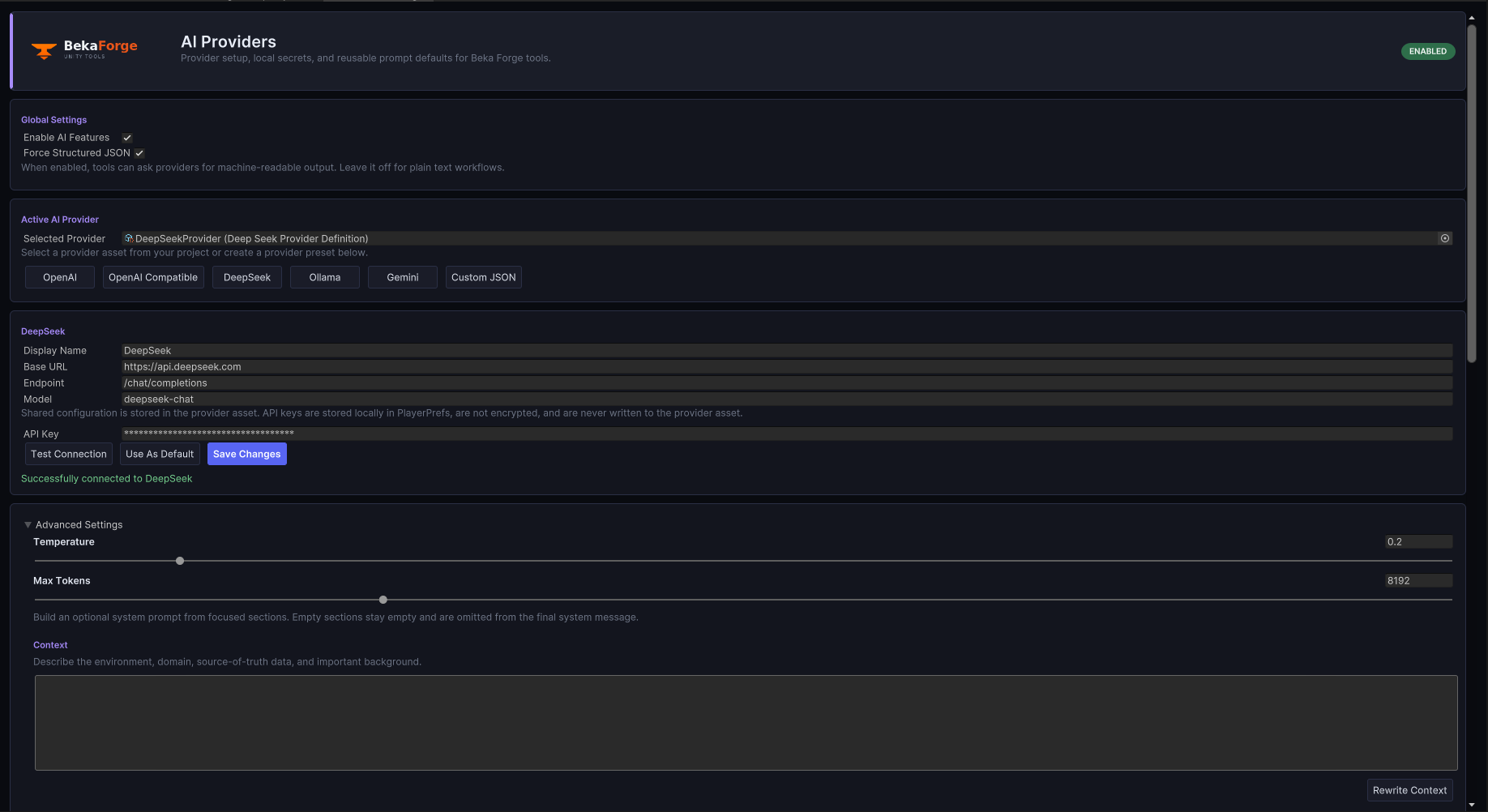
Earlier interface reference
This image is historical orientation only. Follow the live 2.2.0 preview and current guide for the release-candidate interface.
Copy a source-verified minimal request example. Read the response and error handling before connecting it to your game.
Key product boundaries
Standalone transport layer
The package is dependency-free and can be reused by tools outside Dialogue Graph System.
Provider assets over hardcoded switches
Each provider subclass owns its request shape and response parsing instead of relying on one monolithic service switch.
Local secrets, shared config
Provider assets store configuration and remain shareable. Supported protected credential storage keeps API keys local; never put keys in shared assets, screenshots, or a shipped player.
Runtime caveat
TrySendPrompt is obsolete because it blocks. Use the cancellable coroutine path at runtime, or build a snapshot on the main thread and await the async service in editor workflows.
Interactive preview: AI Providers > Profiles, recreated from the product source with fictitious example values. No provider is contacted and no key is stored. Open the full preview or browse the DGS preview.